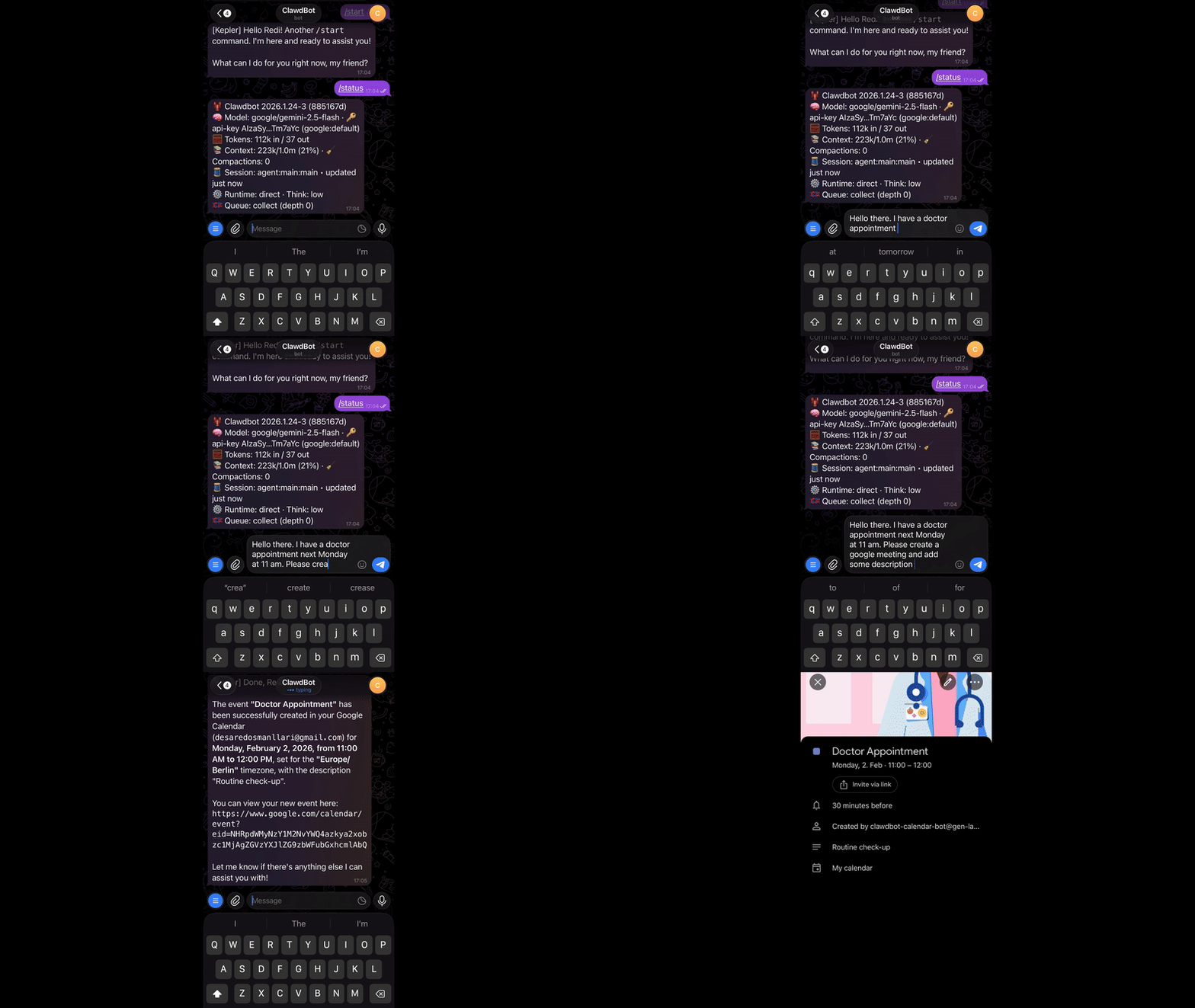
What the assistant actually does
The assistant is a continuous AI integrated into Telegram. It operates around the clock managing calendars, performing web searches, delivering proactive notifications, and automating workflows — all through natural language chat commands.
Unlike session-based AI tools, it runs persistently in the background. It doesn't wait for you to open an app. It reaches out when your next meeting is approaching, reminds you of tasks, and handles multi-step workflows autonomously.
The Architecture
The core architectural decision was building a skill-based decision system. When a message arrives, the system analyzes it and routes it to the appropriate skill module — whether that's calendar management, web search, or workflow automation.
Google's Gemini API provides the reasoning layer, processing natural language into structured actions. The Telegram Bot API serves as the interface layer, making the assistant accessible from any device. Brave Search API enables real-time web queries, and the Google Calendar API handles appointment management.
Everything runs on an AWS EC2 free-tier instance — a single Ubuntu server with 4GB of RAM. The entire system was designed to operate within free-tier constraints without sacrificing reliability or response speed.
Skill-Based Decision Architecture
The system uses a modular skill architecture for API orchestration. Each skill is a self-contained module that handles a specific domain: calendar operations, web search, reminders, and custom workflows.
When you say "Schedule a meeting with the team tomorrow at 3pm", the system detects the calendar skill, extracts the relevant parameters (event name, date, time), and executes the Google Calendar API call. When you ask "What's happening in AI today?", it routes to the Brave Search skill and returns summarized results.
Adding new capabilities means creating a new skill module and registering it. The system is designed to expand without modifying existing code.
Why This Works: Cost-Benefit Breakdown
The recommended cloud setup costs $0 with 24/7 uptime and high-speed responses. We leveraged AWS free-tier for compute, Google's $300 free trial credits for Gemini API, and Telegram's free Bot API for the interface.
The alternative would be expensive hardware like a Mac Mini ($600+) or unreliable, underpowered cloud instances. By properly architecting the system around free-tier constraints, we achieved production-grade reliability at zero cost.
The installation process is streamlined to a single command via the AWS browser SSH console. From a bare Ubuntu instance to a fully operational AI assistant in minutes.
Connectivity & Integrations
The Telegram integration was chosen for its ubiquity and simplicity. Generate an API token via BotFather, connect it to the system, and you have a personal AI assistant accessible from your phone, tablet, or desktop.
Brave Search provides web access without the overhead of browser automation. Google Calendar API enables full calendar management — creating, editing, and deleting appointments through natural language. The skill system makes it straightforward to add new integrations as needed.
What We Learned Building This
The biggest insight was that infrastructure cost and AI capability are not correlated the way most people assume. A well-architected system on free-tier resources can outperform expensive setups that aren't designed with the right constraints in mind.
Proactive behavior changes the entire user experience. The difference between an AI you have to open and an AI that reaches out to you is fundamental — it transforms the tool from an assistant into a genuine companion.
Skill modularity is essential for maintainability. Each capability is isolated, testable, and replaceable. This pattern scales naturally as new integrations become available.